


 Sign in
 CN
CN

How to Calculate the Force Needed for a Lockable Gas Spring — Step-by-Step Guide
 May 28, 2026|
 View:89
Picking the wrong force for a lockable gas spring is one of the most common — and most avoidable — mistakes in equipment design. Too weak, and the spring can't hold the load in position. Too strong, and it becomes difficult to operate. Getting it right the first time saves time, money, and potential safety issues down the road.
This guide walks through exactly how to calculate the correct force for a locking gas spring, from understanding the basic physics to applying a practical formula, using real worked examples. No advanced engineering degree required.
Key Takeaways
The required gas spring force is determined by the load weight, the position of its center of gravity, and the spring's mounting distance from the hinge.
The core formula is: F = (W × L) ÷ (N × D), with a 10–20% safety margin added.
This type of spring must hold static loads in any intermediate position — this requires more precise force selection than a standard gas spring.
Mounting geometry, temperature, and friction all affect real-world performance and must be considered.
Always verify calculated force against the manufacturer's F1 specification before ordering.
1. What Is a Lockable Gas Spring and Why Does Force Calculation Matter?
A lockable gas spring (also called a position-control gas strut) is a pneumatic device that can be held at any point along its stroke with the press of a button or cable release. Unlike a standard gas spring — which pushes or pulls continuously — this type holds a load firmly in place once positioned. This makes it essential in applications like adjustable medical beds, ergonomic seating, industrial workstation arms, and specialized vehicle equipment.
Because this spring type must not only move a load but also hold it stationary at any intermediate angle or height, force selection becomes critical. An undersized unit will slowly drift or fail to hold position; an oversized one creates unnecessary resistance and makes adjustment uncomfortable for the user. Gas springs operate on the principle of compressed nitrogen gas acting on a piston, and the output force is tightly linked to the geometry of the installation.
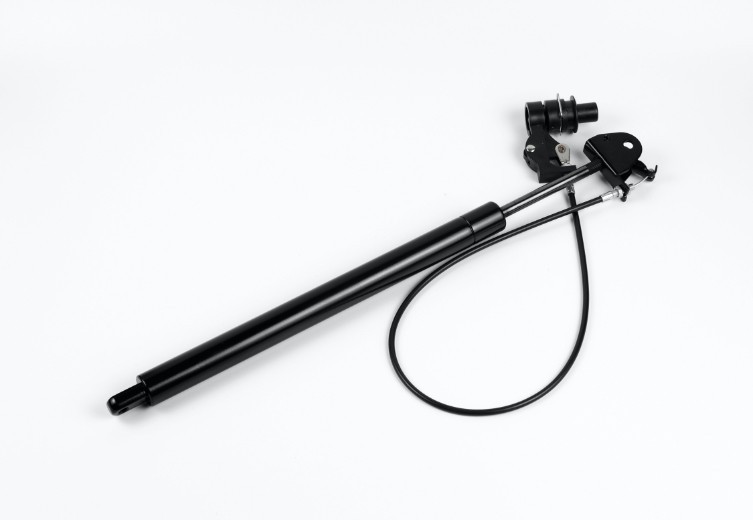
Rigid Lock vs. Elastic Lock: Does the Type Change the Calculation?
There are two main locking mechanisms available:
| Type | How It Locks | Best For | Effect on Force Calculation |
|---|---|---|---|
| Rigid Lock | Piston is mechanically stopped; zero movement after locking | Medical equipment, precision workholding | No change to load formula; requires stricter safety factor |
| Elastic Lock | Locks via internal valve; minor micro-movement remains | Seating, ergonomic furniture, vehicle seats | Same load formula; slightly more tolerance for force deviation |
The force calculation method is the same for both types. The locking mechanism choice affects user feel and application suitability, not the underlying physics.
2. The Key Variables to Gather Before Calculating
Before reaching for a formula, it's important to gather four pieces of information. Every one of these affects the result:
| Variable | Symbol | What It Means | Unit |
|---|---|---|---|
| Total load weight | W | The weight of the moving part (lid, panel, arm) in Newtons. Multiply kg × 9.81 to convert. | N (Newtons) |
| Distance: hinge to center of gravity | L | Horizontal distance from the pivot/hinge point to the load's center of gravity (typically the midpoint of a uniform panel) | mm or m |
| Distance: hinge to gas spring mount | D | Distance from the pivot point to where the gas spring attaches to the moving part | mm or m |
| Number of gas springs | N | Typically 1 or 2; using 2 improves stability and reduces force per spring | — |
3. The Core Force Calculation Formula
The fundamental principle is moment balance: the turning force (torque) created by the load weight around the hinge must be balanced by the opposing torque produced by the gas spring. For a typical top-hinged panel or lid, the formula is:
N = Number of springs | D = Hinge-to-mount distance (m)
This gives the minimum required extension force (F1). After calculating, a safety factor of 1.1 to 1.3 (10–30%) should be applied to account for friction, wear, and real-world variation:
4. Step-by-Step Worked Example
Here is a complete real-world example to show how the formula works in practice.
Scenario: An adjustable medical bed backrest panel needs to be supported by two locking gas springs. The panel weighs 12 kg, is 600 mm long (hinge at one end), and the gas springs will be mounted 450 mm from the hinge.
5. How Mounting Position Affects the Required Force
Mounting geometry is one of the most influential — and most flexible — factors in gas strut force requirements. Moving the mounting point changes the mechanical advantage significantly:
| Mounting Distance (D) from Hinge | Mechanical Advantage | Required Spring Force | Practical Consideration |
|---|---|---|---|
| Very close to hinge (small D) | Low | High force required | May need a much stronger spring; shorter stroke typically sufficient |
| Mid-panel | Moderate | Moderate force | Good balance for most furniture and industrial panels |
| Far from hinge (large D) | High | Lower force required | Best mechanical efficiency; may restrict panel travel or aesthetics |
A practical guideline: mounting the spring at 60–80% of the panel's total length from the hinge provides a good balance of force efficiency and stroke length. Mounting too close to the hinge (below 30% of panel length) typically results in impractically high force requirements and should be avoided if possible.
6. Factors That Modify the Calculated Force in Real-World Applications
6.1 Temperature Effects
Nitrogen gas pressure — and therefore gas spring output force — changes with temperature. As a general rule, gas spring force varies by approximately 3.5% for every 10 °C change. In cold environments (below 0 °C), the force decreases; in hot environments (above 50 °C), it increases. For applications in outdoor machinery, refrigerated areas, or industrial ovens, this variation must be factored into the minimum force calculation.
6.2 Friction in the System
Real installations include friction from hinges, guides, and the spring's own internal seals. A typical internal friction force of 5–10 N is commonly added to the raw calculation for standard spring sizes. This is already accounted for in the recommended safety factor, but for very precise applications (such as medical rehabilitation equipment), friction should be measured and added explicitly.
6.3 Dynamic Loads and Vibration
If the load is subject to vibration, sudden impacts, or dynamic forces — such as in vehicles, industrial machinery, or equipment that experiences regular shocks — the effective load can be 1.5 to 2× the static weight. In such cases, the safety factor should be raised to 1.5 or higher, and consultation with a qualified manufacturer is strongly recommended.
6.4 Opening Angle
The angle at which a panel rests during use changes the effective gravitational moment arm. A horizontal panel (90° from vertical) places the maximum torque on the hinge; an angled or near-vertical panel carries less load moment. If the panel is designed to rest at an angle other than 90°, the formula should be adjusted by multiplying the load moment by the cosine of the resting angle:
For a horizontal surface (θ = 90°), cos(90°) = 1.0 — meaning the full load applies. For a panel at 45°, cos(45°) ≈ 0.71, so the effective load is reduced.
7. Understanding Gas Spring Force Ratings: F1, F2, F3, F4
When reading a datasheet for a lockable gas spring, four force values are typically listed. Understanding the difference is important for correct selection:
| Force Parameter | Definition | Why It Matters |
|---|---|---|
| F1 | Extension force measured at 5 mm from fully extended position | The primary selection value; used in force calculations |
| F2 | Extension force at 5 mm from fully compressed position | Indicates force at maximum compression; always higher than F1 |
| F3 | Compression force at 5 mm from fully extended (pushing in) | Relevant for applications where the spring must be compressed against the gas load |
| F4 | Compression force at 5 mm from fully compressed position | Maximum force during full compression; used for structural load checks |
For spring selection, F1 is the value that should match the calculated required force. Reputable manufacturers provide F1 values as the baseline specification for all their locking gas spring models. The relationship between gas pressure and spring force means F2 is typically 5–8% higher than F1 on a standard stroke.
8. Quick Reference: Force Calculation by Application Type
The table below provides common starting-point force ranges for typical applications. These are for guidance only and must be verified with precise calculations for each specific design.
| Application | Typical Load Range | Typical F1 Range | Springs Recommended |
|---|---|---|---|
| Adjustable medical bed backrest | 8–20 kg | 40–150 N | 2 |
| Ergonomic office / seating armrest | 3–8 kg | 20–80 N | 1–2 |
| Industrial workstation lid or panel | 15–40 kg | 100–300 N | 2 |
| Truck / utility vehicle storage hatch | 10–30 kg | 80–250 N | 2 |
| Medical rehabilitation equipment arm | 5–15 kg | 50–120 N | 1–2 |
| Adjustable drafting table / monitor arm | 5–20 kg | 40–180 N | 1–2 |
9. Common Mistakes to Avoid When Calculating Lockable Gas Spring Force
Forgetting to convert kg to Newtons. Weight in kg must be multiplied by 9.81 to get Newtons before using the formula.
Using the full panel length instead of the center of gravity distance. For a uniform panel, the center of gravity is at the halfway point, not the far end.
Skipping the safety factor. A calculated minimum force is not a safe working specification. Always apply a 10–30% safety margin.
Ignoring temperature range. Springs used outdoors or in controlled environments will see significant force variation if temperature range is wide.
Mounting at too small a D distance. Placing the spring too close to the hinge significantly inflates the required force and can lead to selecting impractical spring sizes.
Selecting force based only on F2 or F4. F1 is the correct specification value for standard load-support calculations.
Not Sure Which Lockable Gas Spring Is Right for Your Application?
COLEWELL's engineering team can help verify your force calculations and recommend the correct locking gas spring model for your specific load, stroke, and environment requirements.
Get a Free Engineering ConsultationCustom force, custom stroke, OEM orders welcome · ISO certified manufacturer10. How to Verify the Calculation Before Ordering
Once the force value has been calculated, there are several ways to cross-check the result before committing to a purchase:
Reverse the calculation. Take the manufacturer's listed F1 value and back-calculate to confirm it produces a moment that balances the load at the intended angle.
Use a simple test rig. If a similar spring is available, temporarily mount it and check whether the load is held securely at all required positions.
Consult the manufacturer. Reputable suppliers will review the application details and confirm or adjust the specification. COLEWELL, for example, offers engineering review as part of the inquiry process.
Reference published sizing guides. Engineering reference resources on gas spring mechanics provide background validation for the moment-balance approach.
11. Choosing the Right Lockable Gas Spring: Beyond Force
Force is the most critical specification, but it is not the only one. When selecting a position-locking gas strut, the following parameters should also be confirmed:
| Parameter | What to Check |
|---|---|
| Stroke length | Must match the required travel distance of the moving part; typically 40–500 mm |
| Compressed length | Overall length when fully closed; must fit within available space |
| Rod diameter | Standard sizes: 6 mm, 8 mm, 10 mm, 14 mm; affects load capacity and rigidity |
| End fittings | Ball socket, clevis, or eye; must match installation geometry |
| Release mechanism | Push-button, cable pull, or external valve; choose based on ergonomics and access |
| Operating temperature range | Standard: -20 °C to +80 °C; confirm with manufacturer for extremes |
| Material / corrosion resistance | Chrome-plated steel is standard; stainless steel available for outdoor or marine use |
Summary
Calculating the correct force for a lockable gas spring comes down to understanding the geometry of the installation and applying the moment-balance formula: F₁ = (W × L) ÷ (N × D), then adding a safety factor. The mounting position (D) is the single most adjustable variable and can make a significant difference in the spring specification needed. Temperature, friction, and opening angle all refine the result. Always verify against the F1 value in the manufacturer's datasheet, and when in doubt, consult the supplier's engineering team before ordering.
Whether the application is a medical bed, an ergonomic workstation, or an industrial equipment panel, the calculation steps remain the same — what changes is the specific values and the appropriate safety factor.
Frequently Asked Questions (FAQ)
Looking for a reliable lockable gas spring manufacturer for custom or OEM requirements? COLEWELL (Changzhou Colewell Machinery Co., Ltd.) is an ISO-certified manufacturer specializing in locking gas springs and adjustable lockable gas springs with release buttons for medical, furniture, industrial, and automotive applications. Custom stroke, force, and end-fitting configurations are available with engineering support.

